

Muscadine history & the Ison family go together.
Have you ever wondered why so many muscadine varieites have the name FRY?
Dr. B. O. Fry. The man behind the name.
Fry. Black Fry. Early Fry. Late Fry. Fry Seedless.
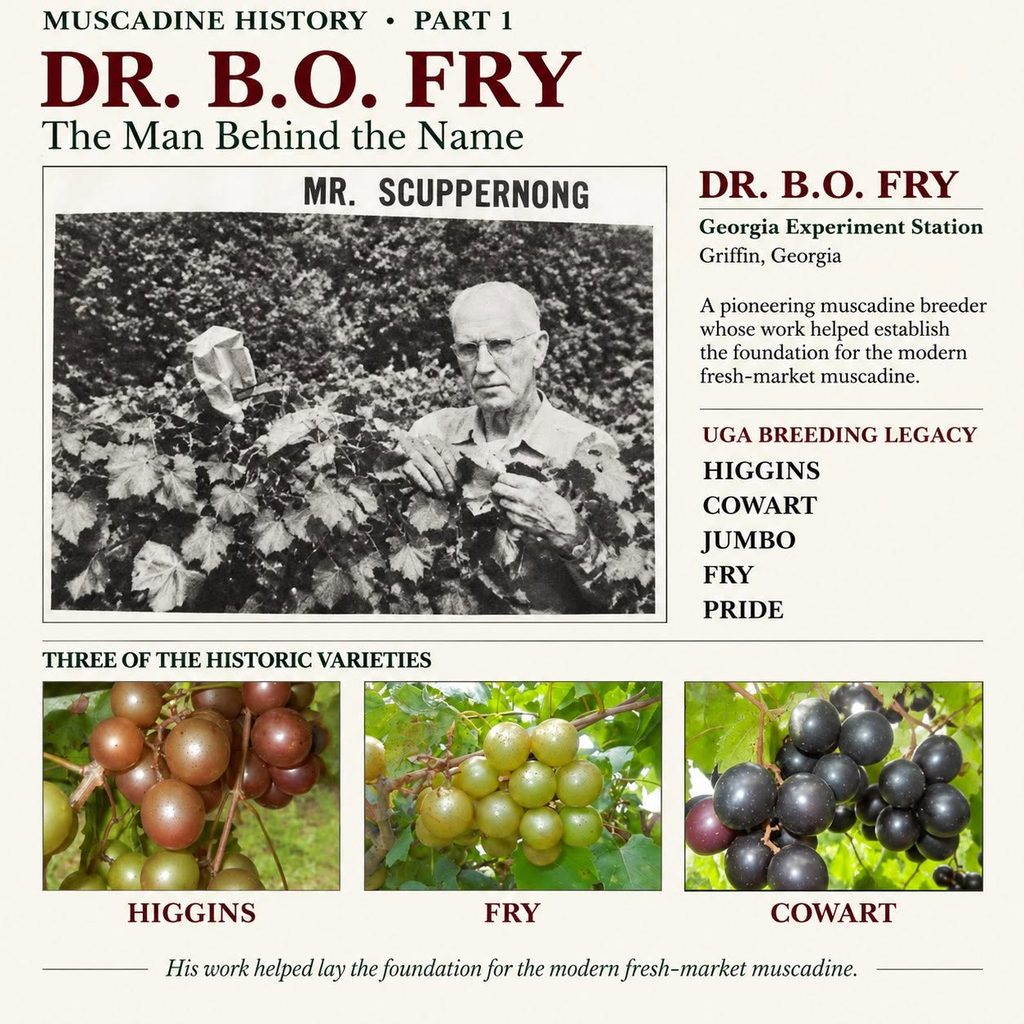
Those names aren’t a coincidence. They honor a man whose life’s work helped change the muscadine industry: Dr. B.O. Fry
Long before he became our father’s best friend and breeding partner at Ison’s Nursery, Dr. Fry was doing groundbreaking muscadine breeding at the University of Georgia’s Georgia Experiment Station in Griffin, Georgia.
From 1951 through 1968, Dr. Fry directed an important era of UGA’s muscadine breeding program.
He was searching for a better muscadine. At the time, fresh-market muscadines were very different from many of the large, beautiful varieties we enjoy today.
Dr. Fry concentrated on characteristics that would prove extremely important:
 Larger fruit Higher sugar Better flavor and eating quality Improved fresh-market potential
Among the important varieties resulting from his UGA breeding work were:
HIGGINS • COWART • JUMBO • FRY • PRIDE
But Dr. Fry’s importance goes far beyond a list of varieties. Higgins, released in 1955, produced significantly larger fruit than many earlier cultivars and became an important parent in future crosses. Its genetics can be found in other important Dr. Fry varieties, including Jumbo, Cowart and Fry. And then came the muscadine that would carry his own name.
FRY
Fry helped change expectations for what a fresh-market muscadine could be. Large, bronze, sweet and flavorful, it became one of the most important fresh-market muscadines of its time. For decades, Fry became the standard against which other fresh-market muscadines were measured.
Its influence didn’t stop there. UGA’s history of muscadine breeding credits the cultivars developed during Dr. Fry’s era with providing much of the genetic foundation for the fresh-market muscadines that followed.
Think about what that means. His work didn’t end when a new variety was named and released. Those varieties became parents.
Their offspring became parents. And Dr. Fry’s genetics continued into new generations of muscadines. His work helped lay the foundation for the modern fresh-market muscadine industry.
But in 1968, Dr. Fry retired from the Georgia Experiment Station. His remarkable career at UGA was ending.
His work with muscadines WAS NOT. Because another man had a dream of his own.
His name was William G. “Bill” Ison. And when these two men joined forces, another extraordinary chapter in muscadine history was about to begin.
Darlene Ison Evans
Ison’s Nursery & Vineyard
Watch for Part 2: